
Ndutu, southern Serengeti
What Calving Season Teaches You About Patience
Eight thousand wildebeest are born on the Ndutu plains on a good day in February. The temptation is to drive between all of them. The animals I remember are the ones I stayed with.
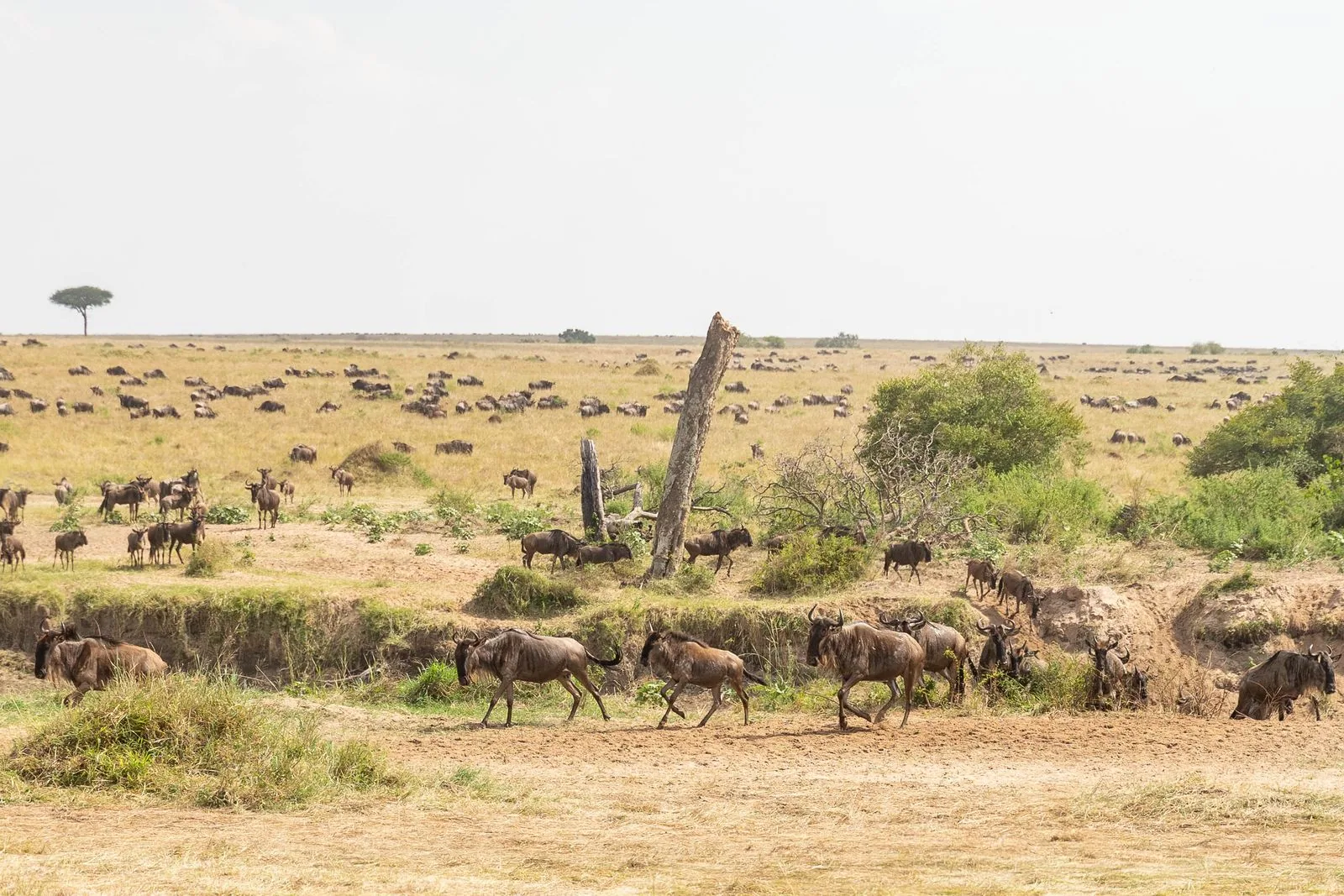
The short-grass plains south of the Serengeti are, for most of the year, the emptiest-looking country in Tanzania. Volcanic ash from the Ngorongoro highlands laid down a shallow hardpan there, and almost nothing woody will grow on it. What grows instead is grass with an unusually high mineral content, which is the entire reason for everything that follows: a lactating wildebeest needs calcium and phosphorus far more than she needs shade, and this is where she gets them.
So between late January and the middle of March about half a million calves are born on ground with no cover on it at all, in front of every predator in the ecosystem, and the whole strategy rests on doing it all at once. Swamp the market. A calf born inside the peak fortnight has a far better chance than one born three weeks either side, and the herd knows it.
The temptation, and why it is wrong
On my first February at Ndutu I drove about a hundred and forty kilometres in a day. There was a radio call about a leopard, and while we were going to the leopard there was a call about a cheetah with cubs, and while we were going to that a lion killed something behind us. I photographed six species and I have not looked at any of those files since.
The next February I picked one cheetah and stayed with her for three days. I have printed four frames from those three days. The difference is not luck and it is not equipment. It is that a predator you have watched for six hours starts doing things in front of you that a predator you have watched for six minutes never will, and — more to the point — you start being able to see them coming.
Everything worth seeing out here is preceded by about forty minutes of nothing, and the only way to be there for the something is to sit through the nothing.
What the waiting actually looks like
A cheetah hunting on open plain telegraphs her intent for a long time before she moves, and almost none of it is dramatic. She sits up. She looks at one part of the horizon for longer than the rest of it. Her ears come forward and stay forward. She walks, but on a line that keeps a single low fold of ground between her and the herd — and you only notice the fold exists because she is using it.
If you are three hours into the morning with her, you see all of that and you have time to turn the vehicle, kill the engine, get the light behind you and be ready. If you have just arrived on a radio call, you see a cheetah sitting in the grass, and then you see a cloud of dust four hundred metres away with a vehicle in front of it.
Births happen early, and they are quick
Almost everything is born in the first hours of light. A cow will separate a short way from the herd, lie down, and be finished in a few minutes. The calf is on its feet inside six and moving with the herd inside half an hour, which is the tightest survival margin of any large mammal I know of. If you are not out of camp before six you are not watching births, you are watching the aftermath of them.
This is the one place I will push guests on their alarm clocks. Not because early light is prettier — although at Ndutu in February, with a storm building on one side of the sky, it is the best light of the year — but because the event you came for happens in a two-hour window and does not repeat in the afternoon.
Green season, and the thing nobody mentions
February at Ndutu is the green season. That means afternoon storms, some black cotton mud on the tracks, and light that is completely different from the flat white glare of August. It also means far fewer vehicles than the same ecosystem gets in the dry months, and lodge rates that are meaningfully lower for the same rooms.
The thing nobody mentions is that green season is also when the plains are at their most beautiful in a way that has nothing to do with animals. The short grass goes an improbable colour, the sky does something enormous every afternoon at four, and you can see forty kilometres in three directions. People arrive to photograph cats and go home with landscapes.
How to actually do it
What changes a February at Ndutu
- Be out before six with everything for the day in the vehicle. Coming back to camp for lunch costs you the middle of the day, which is when the cats move to new shade and give themselves away.
- Pick one animal in the morning and give it three hours before you consider leaving. Set a rule and hold to it; the radio will test you inside twenty minutes.
- Ask your guide to switch the engine off and leave it off. Half of what you want to hear is inaudible over a diesel at idle, and animals settle around a silent vehicle in a way they do not around a running one.
- Take five nights on the plains rather than two. The calving front moves, the resident prides do not, and the third day is when you stop being a visitor and start knowing where things are.
None of that is a technique so much as a decision about what kind of trip you want. You can see a great deal at Ndutu in three days of driving hard. You will remember a great deal more from five days of sitting still, and the pictures will be better, and so will the mornings.